Subscription tracking
Catch the $0 trial before it becomes a $99 bill.
Other apps detect subscriptions from your transactions — after you’ve been charged. GlidePath flips it around: enter the promo-end and cancel-by dates up front, and we surface the rollover 30 days before it hits — while you can still cancel for free.
The trap, and why other apps miss it.
The trap
You sign up for “$0 the first year, then $99/year after that.” You mean to cancel before the renewal. Twelve months later you forget, and a charge shows up on a card you barely check — sometimes for years before anyone notices.
Why other apps don’t help
Mint, Simplifi, Monarch, and Copilot all detect subscriptions from your transactions — after the charge. By then the money’s gone and you have to call to get it back. GlidePath warns you before the rollover, from the dates you entered when you signed up.
What the screen is telling you.
Every subscription, and the warning you actually want — the one that shows up before the charge does.
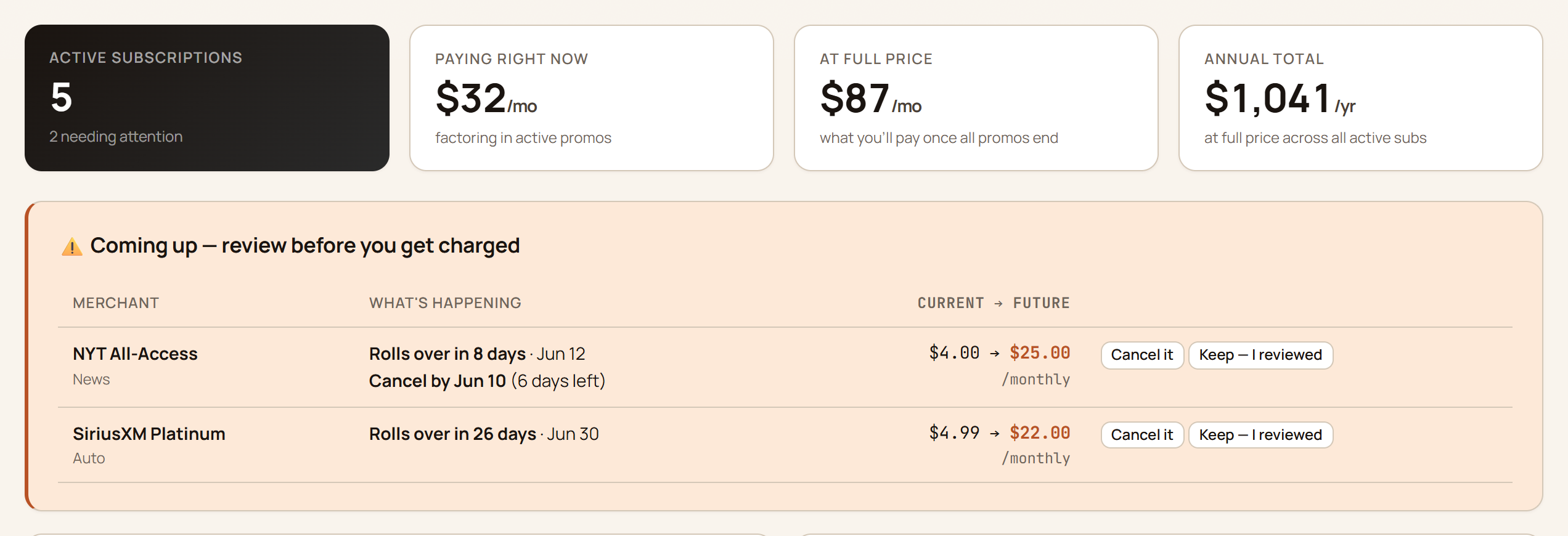
- Everything recurring, counted Every subscription in one place — and how many need a decision from you right now.
- Now vs. full price What you pay today ($32/mo here) and what it jumps to once the promos end ($87/mo) — the future bill other apps never show.
- The 30-day warning Trials and renewals about to roll over, surfaced before they bill — while you can still cancel for free.
- The exact price jump Before and after, side by side, so a quiet 6× increase ($4 → $25) can’t slip past you.
- Decide right here Cancel it, or mark it reviewed to clear it from the list — no more nagging.
For every active subscription, you see
- Days until rollover — color-coded by urgency, surfaces the soonest deadlines first.
- Cancel-by date if different from the rollover (some services need 7–30 days notice).
- Current price → future price side by side, so the cliff is impossible to miss.
- Annual roll-up — what you’re paying now vs. what you’ll pay once every promo ends.
- One-click actions on the warning row: Cancel it or Keep — I reviewed.
- Status history — cancelled subs stay in your data with the date and reason, so you can spot patterns.
One caught rollover can cover the price of the app. We’ve seen $98 Walmart+ renewals, $300 anti-virus auto-renews, and $720 newspaper-bundle rollovers that you’d otherwise have eaten for a year before noticing.
What this catches — the subscriptions you don’t think of as subscriptions.
Netflix and Spotify aren’t the problem. Everyone knows they’re subscriptions. The expensive ones are the ones that don’t feel like subscriptions — the ones that bill once a year, or that you signed up for once and never thought about again.
Membership programs
Walmart+ ($98/yr), Amazon Prime ($139/yr), Costco ($65 or $130/yr), Sam’s Club ($50 or $110/yr), Instacart+ ($99/yr), DoorDash DashPass ($96/yr), Uber One ($99/yr). Annual or monthly billing — easy to miss either way.
News intro pricing
NYT, WSJ, Washington Post, The Atlantic, Bloomberg. The intro is usually $1–5/mo. The rollover is often $20–30/mo — a 5–10× jump that’s easy to miss because the charge looks like the others on the statement.
Auto-renewing software & services
Sirius XM (the classic example — ~$5/mo intro rolling to $22+/mo at renewal), Adobe Creative Cloud, Microsoft 365, Norton & McAfee (notorious for opaque renewal prices), TurboTax, 1Password, password managers, iCloud+, Google One. Most renew silently, often at a much higher price than the intro.
Warranties & memberships
AppleCare+, AAA, BestBuy Total Tech, Carfax subscriptions, gym memberships, club memberships, domain renewals at Namecheap or GoDaddy (often inflate sharply at renewal).
Auto-ship & boxes
Chewy Autoship, BarkBox, Birchbox, HelloFresh, Blue Apron, ButcherBox, Dollar Shave Club, Harry’s. Most run on monthly cadence with annual loyalty discounts that quietly auto-renew.
Free trials that auto-convert
The whole point of “free trial, cancel anytime” pricing is that most people don’t cancel in time. We let you log the trial with its auto-convert date, so it surfaces before you’ve been charged even once.
Why this is rare elsewhere.
There are subscription trackers and there are personal-finance apps. The category rarely built well is a finance app that warns you before a rollover.
Detection happens after the charge.
Mint (RIP), Simplifi, Monarch, and Copilot identify subscriptions by looking at your transactions and grouping recurring charges. That works — after you’ve been billed. The whole point of catching a rollover is to act before the bill hits, which detection-based tools structurally can’t do.
Cancellation services charge for what should be automatic.
Rocket Money (formerly Truebill) puts its cancel-it-for-me concierge behind a $7–14/mo Premium plan, and its separate bill-negotiation service keeps 35–60% of your first year’s savings as a one-time fee. We’d rather you knew the rollover was coming and cancelled it yourself in two minutes for free.
Single-purpose apps don’t connect to your finances.
Bobby and similar iOS apps let you log subscriptions manually, which is the right idea — but they live in a separate app from your budget and your net-worth tracker, so the annual roll-up of "what am I really paying for subscriptions?" never reaches your planning.
How it works, step by step.
1. Add a subscription
Merchant, current price, billing cycle, promo-end date (if any), cancel-by date (if any), post-promo price. Takes about 30 seconds per entry — most of the time copy-pasting the merchant’s confirmation email.
2. Watch the warnings surface
Anything renewing or rolling over in the next 30 days appears in the “Coming up” panel on the page, color-coded by urgency. Items also flow into the Action Queue on the home page so you see them even if you’re not on the Subscriptions tab.
3. Decide before the rollover
Two buttons on every warning row: Cancel it (we update the status; you cancel through the merchant) or Keep — I reviewed (we update the status, stop warning you about this one, and roll the price up for the annual forecast).
4. See the annual picture
The summary cards at the top show what you’re paying right now vs. what you’ll pay once all the promos roll over. The delta between the two is the money you’re about to start spending if you don’t act.
Catch the next rollover before it costs you.
$129 one-time. Unlimited subscriptions tracked. Stop paying any time and the app keeps working — your data is yours forever.