RSU tax at vest
See the tax your RSUs trigger the day they vest.
When restricted stock units (company shares that vest on a schedule) vest, they’re taxed as ordinary wages — and payroll withholds at a flat 22% federal rate that often isn’t enough for a high earner. GlidePath estimates what’s withheld at each vest and the marginal true-up — the federal gap you may still owe at filing. It shows the math; it doesn’t tell you what to do.
Why the number on your pay stub can mislead you.
The IRS treats an RSU vest as a “supplemental wage” — a one-off chunk of pay, like a bonus.
Payroll handles it with a flat 22% federal withholding (rising to 37% on the part of your cumulative supplemental wages above $1M in a year). That’s convenient for payroll — but if your real marginal rate (the rate on your next dollar of income) is 32% or 35%, a flat 22% withheld leaves a gap you may have to settle at tax time. Plenty of people see a healthy vest, see tax already taken out, and don’t find out about the shortfall until April. GlidePath puts that gap on screen now, in plain numbers.
Shown with a fictional demo household — sample data, never real holdings.
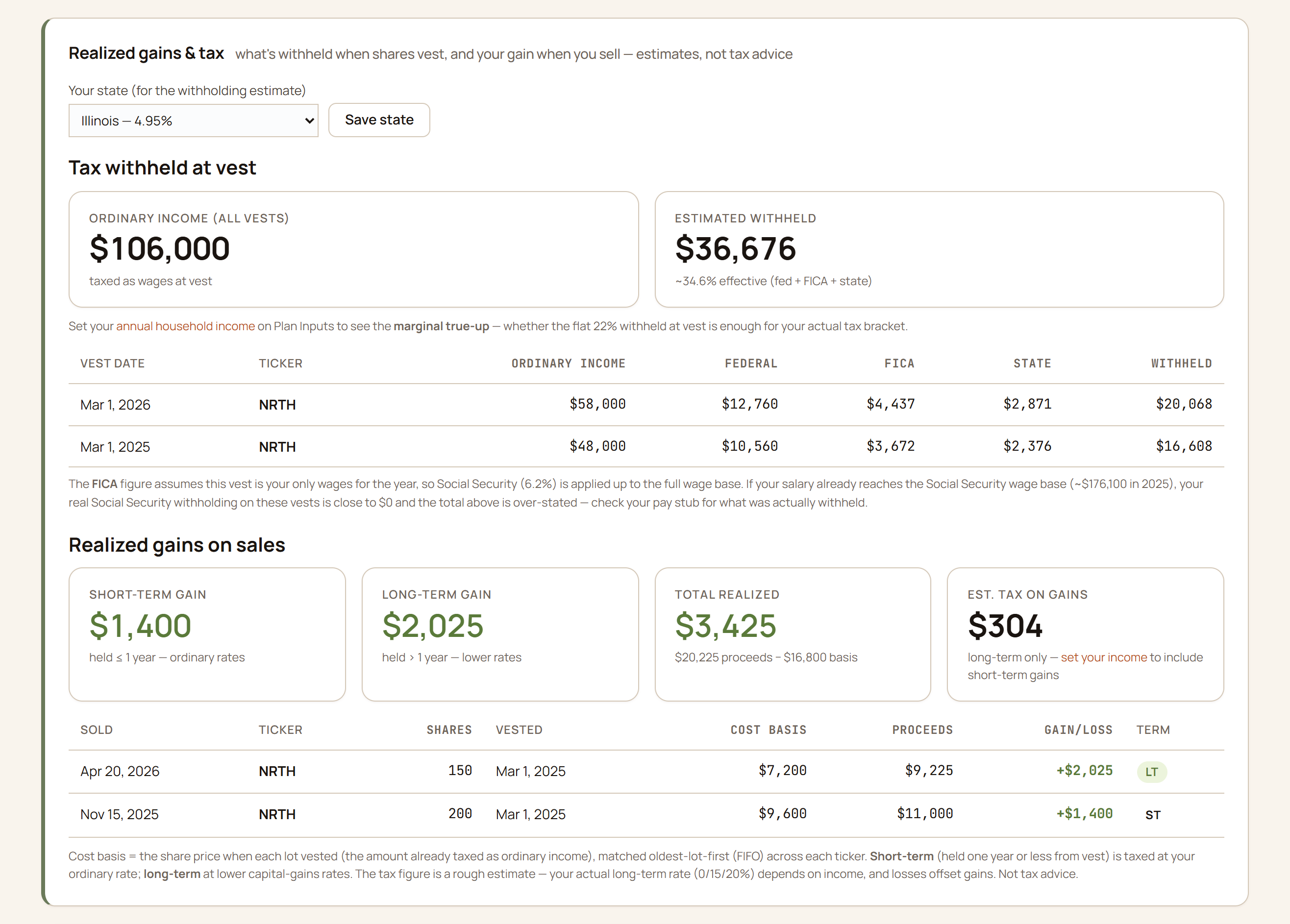
Fictional demo household · sample data. Each vest shows ordinary income, federal, FICA, state, and total withheld; set household income on Plan Inputs and the marginal true-up appears beside them. Every figure is an estimate to plan with, not tax advice.
What the tax-at-vest view shows.
Withheld at each vest
For every past vest with a known price, GlidePath estimates the ordinary income (shares × the price at vest) and breaks the withholding into federal 22%, FICA (Social Security and Medicare), and state — then totals them with an effective rate.
The marginal true-up
Enter your annual household income on Plan Inputs and GlidePath estimates your marginal federal rate, then shows the true-up — the federal gap between the flat 22% withheld and your bracket. A plus means you may still owe at filing; a minus leans toward a refund. Federal only, and an estimate.
Pick your state
Choose your state of residence and the state-withholding estimate sharpens (it’s treated as 0% until you do). For states without one published supplemental rate, GlidePath uses the top rate as a conservative, clearly-labeled estimate — check your pay stub for the exact figure.
It shows the gap. It doesn’t tell you what to do about it.
That distinction matters to us, and it should matter to you.
GlidePath estimates and shows: here’s the income each vest created, here’s what was likely withheld, and here’s the federal gap against your bracket. It does not tell you to make an estimated payment, adjust your W-4, or sell shares — those are your calls, ideally with a CPA. The point is to see the number before April instead of being surprised by it, so the conversation with a tax professional starts from real figures.
A few honest caveats GlidePath states right on the panel: the true-up is federal only (FICA and state are withheld separately), and the FICA figure assumes the vest is your only wages for the year — so if your salary already passed the Social Security wage base, the real Social Security piece is closer to zero and the total reads high. Check your pay stub for what was actually taken.
A calculator that’s also the rest of your plan.
A one-off web calculator forgets you the moment you close the tab.
GlidePath keeps your grants, so the tax-at-vest figures sit next to the vesting schedule and employer-stock concentration, your realized gains when you sell (first-in-first-out, split short- vs long-term, with cost basis from the vest-day price), and a retirement plan that leaves unvested shares out by default. It’s the same data, read four ways — not four disconnected tools. See the whole equity page for how it fits together.
Questions about RSU tax at vest.
How much tax is withheld when RSUs vest?
Vested RSUs are taxed as ordinary wages. Payroll withholds a flat 22% federal supplemental rate (37% on cumulative supplemental wages over $1M), plus FICA and your state. GlidePath estimates each per vest and totals them — an estimate, not tax advice.
What is the RSU withholding gap?
It’s the difference between the flat 22% withheld and your real marginal bracket. If your bracket is higher, the flat rate under-withholds and you may owe the gap at filing. GlidePath shows it as the “marginal true-up” once you enter your household income.
Does it tell me what to do?
No. It shows the math — the income, the withholding, and the gap — so you can plan and talk to a CPA from real numbers. It doesn’t recommend payments or trades.
Is there a subscription?
You buy a desktop license — $129 Personal, $199 Personal + Business — and the installed version keeps working if maintenance lapses. The first year of updates is included; after that $39/yr keeps tax rules and bank parsers current (auto-renews, cancel anytime). Future major versions may be optional paid upgrades, with clear terms before you decide.
See your vest tax, then plan around it.
$129 desktop license for Personal, $199 for Personal + Business. First year of updates included, then $39/yr keeps you current (auto-renews, cancel anytime); stop any time and the app keeps working — in full. Your equity data stays on your own computer.
GlidePath shows estimates and assumptions — the flat 22% supplemental rate, FICA, state, and a federal marginal true-up — so you can plan and have a sharper conversation with a tax professional. It is not tax or investment advice. For your specific situation, talk to a CPA.